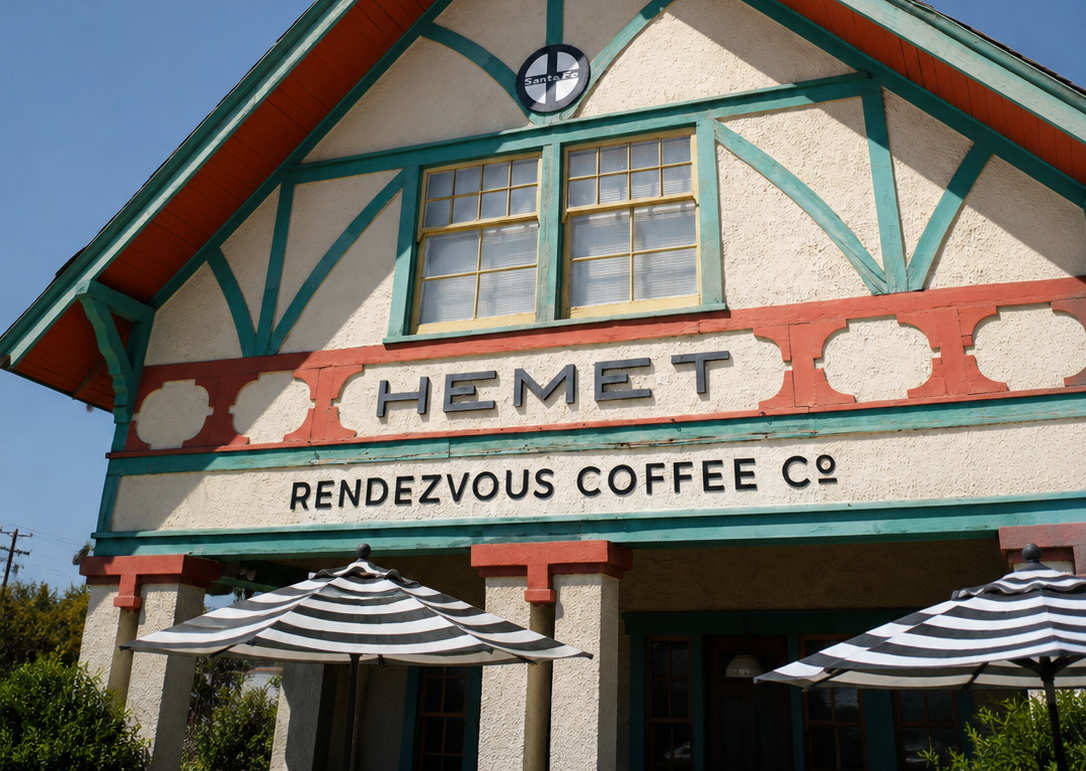
Next Stop: Extraordinary Coffee
Rendezvous Coffee Company brings serious brewing, easy hospitality, and a twelve-hour experiment to one of Hemet’s most historic spaces.
_______________________________________
by Christopher Rael June 24th, 2026
There is something wonderfully fitting about opening a coffeehouse inside an old train depot. A depot was never merely a building where people waited for transportation. It was a place of greetings and goodbyes, chance encounters, lingering conversations, and people crossing paths on their way somewhere else.
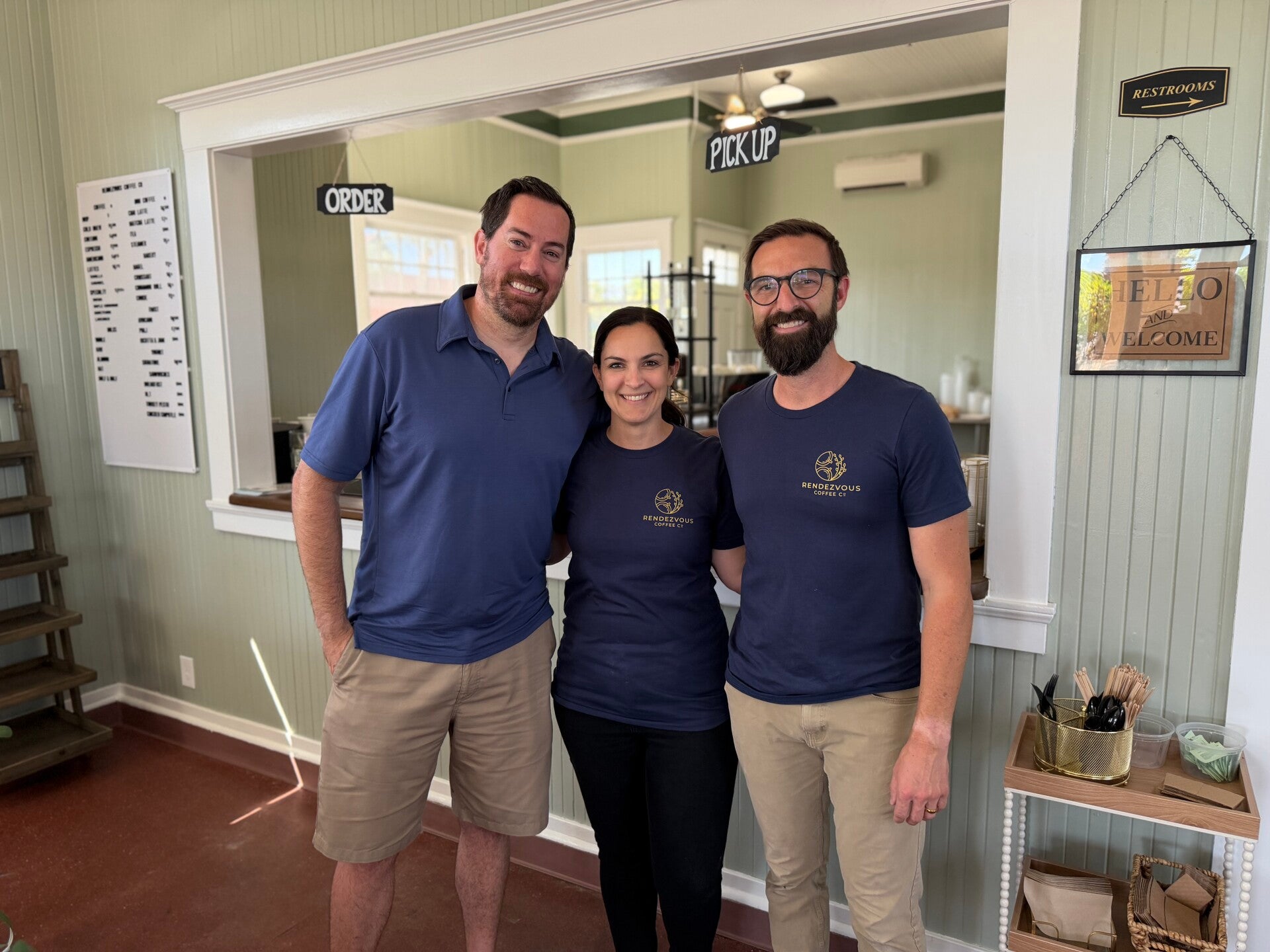
Now, inside the historic Hemet Depot, Mike and Janna Thezier and their business partner, Jason Harrison, are bringing that spirit back with Rendezvous Coffee Company.
The name itself carries some of that meaning. Mike’s family roots reach back to France, and the idea of a rendezvous—a meeting place—grew naturally from that family connection as well as from Mike and Janna’s years of travel. They wanted more than a place where someone rushes in, grabs a coffee, and disappears. They wanted to create a place where people come together, settle in, and spend some time.
They have done exactly that. The space feels inviting in a real and unforced way. There are comfortable couches, chairs, and tables that make you want to stay rather than hurry out the door. Outside, there is also a patio with tables, chairs, and umbrellas, offering another place to sit and enjoy the surroundings. It is the kind of setup that quietly tells people they are welcome to linger. You can stop in for five minutes, but the whole place seems designed to encourage fifty.
When you are sitting in a place like Rendezvous, you feel as though you have wandered into a Morgan Eckroth video—everything warm, centered, and quietly reassuring, as though the place somehow gets you.
Before moving into the depot, the team had already built a successful coffee trailer business, so this is not a case of people opening a coffee place on enthusiasm alone. They know how to make coffee, they know how to serve customers, and they know how to run an operation. The depot simply gives them the chance to turn something mobile and already proven into a permanent home.

They are also deeply serious about the craft. They roast the coffee they serve, and they use direct coffee, meaning it comes straight from the places they source it from rather than through a long chain of middlemen. That creates a closer connection between the growers and the final cup being served in Hemet. The city is helping them acquire industrial roasting equipment so they can stop roasting at home and scale the operation.
That says something important: this is not just a cozy little coffee shop dream. It is a real business with experience, vision, and room to grow.
Their menu, at least for now, is simple and smart: avocado toast, bagels, pastries, and other food that feels right alongside a cup of coffee. Behind it all is a very functional kitchen and a thoughtfully designed work area. Nothing feels improvised. The entire setup gives the impression of people who have thought through how the business should work, not just how it should look.
And then there is the coffee itself. Their brewing setup would make a dedicated coffee obsessive stop and ask questions immediately. They can do pour-overs, French press, espresso, and a range of other brewing methods that would make most casual coffee drinkers realize there is a whole world beyond “regular” coffee.
They know this world well. In fact, they would probably give James Hoffmann a run for his money when it comes to the number of ways they know how to brew and think about coffee.
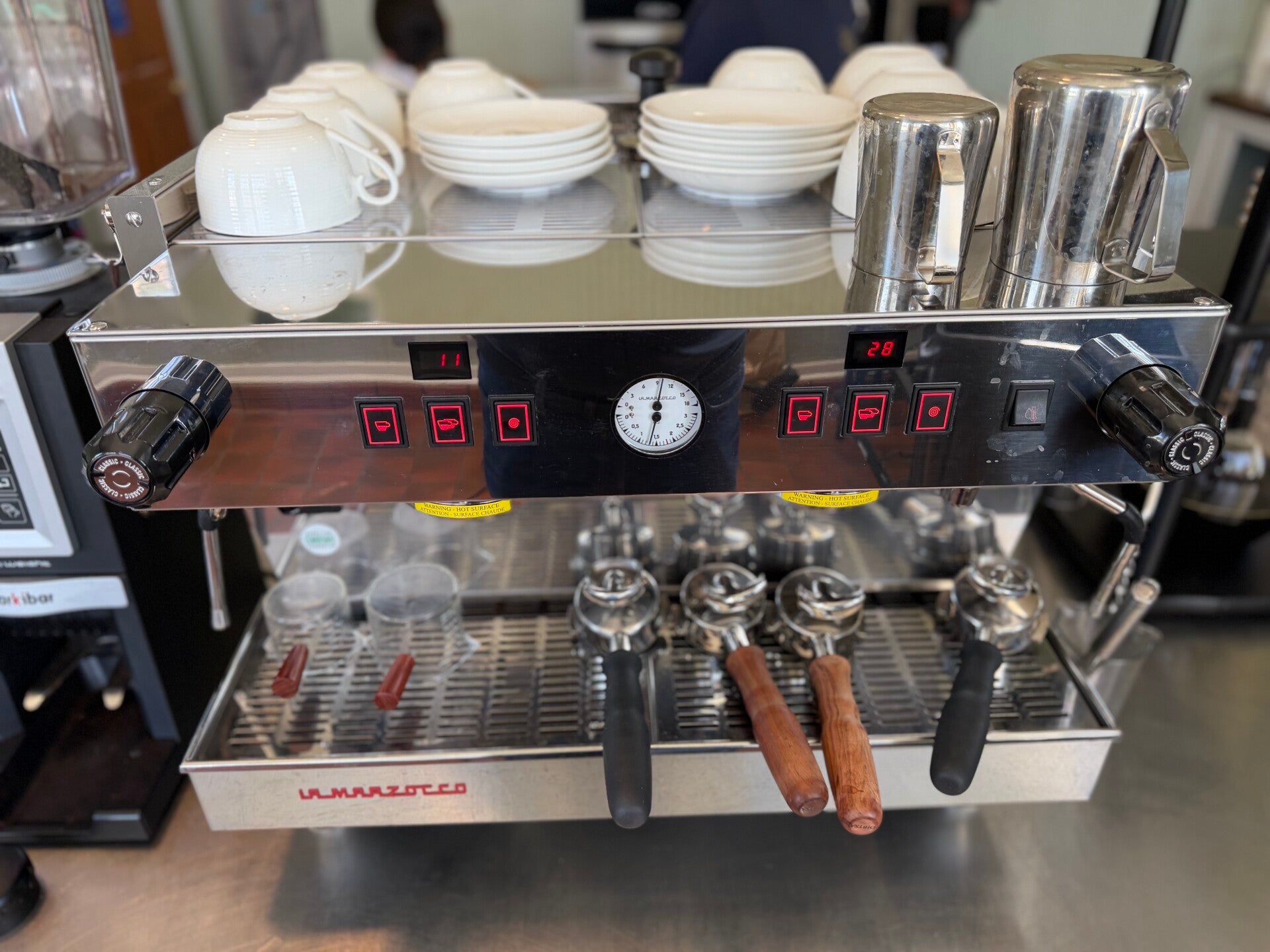
The centerpiece of all this, though, is the espresso machine. They were particularly proud of it, and rightly so. They showed it off in detail, explaining its features and how it works with the unmistakable pride of people who know exactly what they are doing and love the tools of their craft.
The machine looks less like a standard appliance and more like something out of NASA Mission Control—a gleaming arrangement of polished metal, gauges, handles, controls, and precision engineering that seems capable of launching either a satellite or a perfect cappuccino. It is not just equipment to them; it is part of the show, part of the identity of the place, and part of the promise that this is serious coffee.
Mike also showed me one particular brewing method he was excited about, a way of making a very strong coffee concentrate that could then be used for iced coffee drinks. Watching him explain it and demonstrate it was part chemistry experiment, part engineering exercise, and part magic trick.
The result was impressive—strong, smooth, and clearly the product of someone who enjoys both the process and the outcome. It is easy to imagine that Janna’s background as a high school math teacher also fits naturally into this world. Good coffee depends on precision: timing, ratios, water temperature, grind size, and consistency. A small change here or there can alter everything. At Rendezvous, those small things are not left to chance.
What also stands out is the demeanor of the people behind the business. Mike, Janna, and Jason are affable, personable, and approachable. They have an easy manner that immediately makes the space feel welcoming.
At the same time, throughout the visit they were fully on point, making sure their staff had their questions answered and whatever they needed in the moment. They were attentive without seeming tense, engaged without hovering, and clearly in command without ever putting on a performance of being in command.
They have that air of people who know exactly what they are doing, so from the outside it all looks effortless. Of course, effortless is usually what competence looks like when someone has put in the work.
That may be the most reassuring quality of the place. Nothing feels trendy for the sake of trendiness. Nothing feels like imitation. Instead, it feels like a business created by people with real experience, real taste, and a real desire to give something back to the Hemet community.
They have not just opened a coffee counter. They have created an environment. They want people to come in, visit, sit down, spend time, and enjoy themselves.
That is the quiet logic behind Rendezvous and its simple invitation: Meet. Drink. Enjoy.
Meet someone there. Drink something made with unusual care. Enjoy the fact that, for once, nobody seems to be rushing you toward the door.
And that matters. Hemet does not simply need another place selling coffee. It needs more spaces where people feel comfortable coming alone, meeting a friend, reading for a while, having a conversation, or simply enjoying a well-made drink in a historic setting. It needs places with personality and warmth, businesses that feel grounded in the city rather than imported from somewhere else.
Rendezvous Coffee Company belongs in the old depot because both the business and the building are, in the end, about connection. A century ago, the depot connected Hemet to other places and carried people toward new destinations. Today, it can connect neighbors to one another.
The trains may no longer arrive the way they once did, but the old depot is becoming a meeting place again.
This time, the arrivals carry laptops, books, families, and conversations. The departures may leave with a bagel, a pastry, an espresso, or a beautifully prepared iced coffee. But between arrival and departure, something more important happens.
People gather. They pause. They talk. They stay awhile.
And that, in the best sense of the word, is the rendezvous.
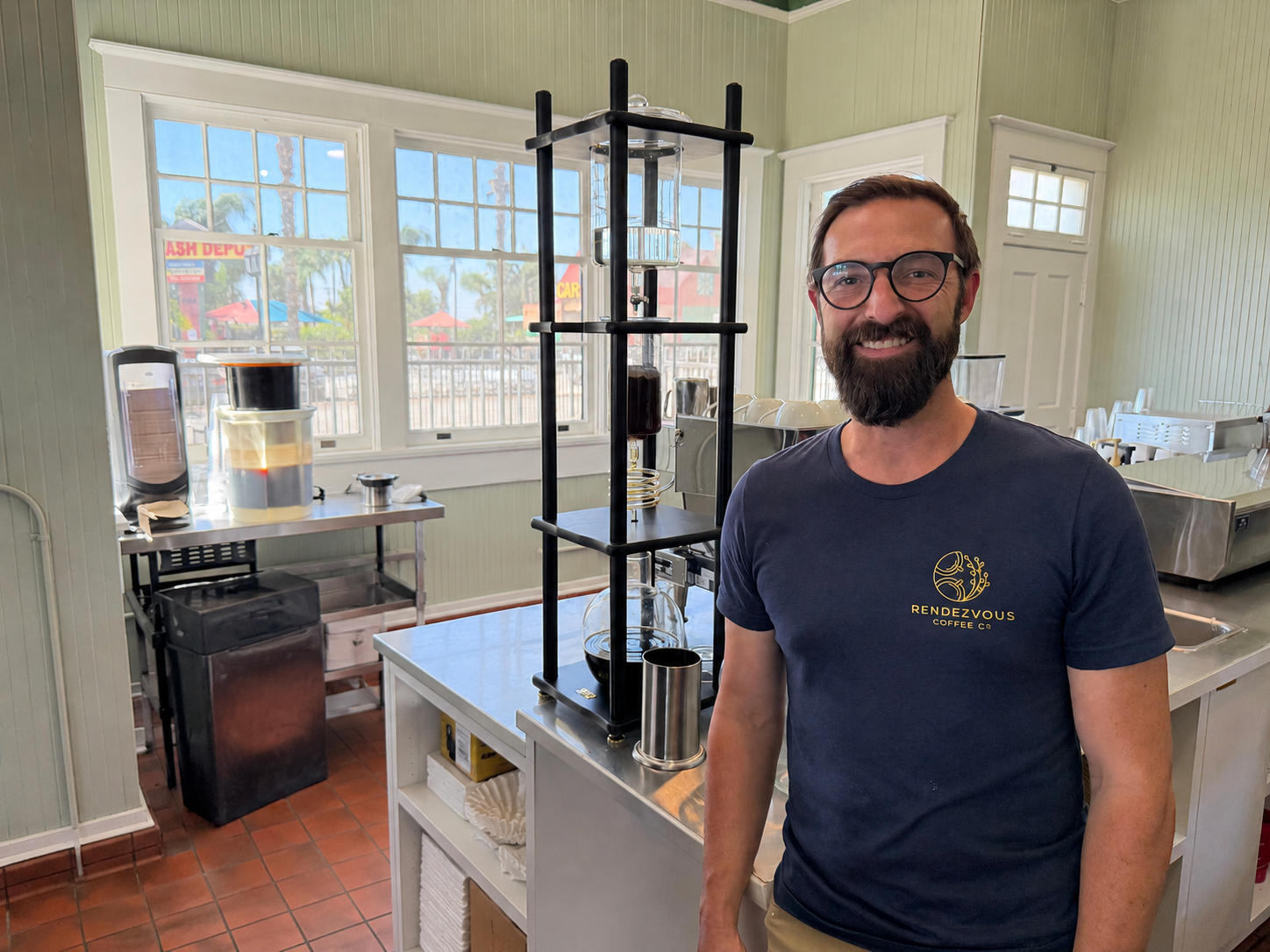
The equipment makes the room feel part coffeehouse, part Museum of Modern Art installation, and part Nikola Tesla’s laboratory. But standing front and center is the piece that immediately draws the eye. Calling it a coffee machine hardly does it justice. It looks as though someone cleared out a college chemistry laboratory and decided to put the equipment to work making coffee instead: coiled glass tubes, containers, clamps, and a slow, deliberate drip falling one drop at a time into a beaker below.
I stood there looking at it for a moment before finally asking the only reasonable question.
“What the heck is this?”
Mike explained the entire process—and explained it very well—but somewhere between the coils, the timing, the extraction, and the controlled dripping, the science sailed cleanly over my head.
I understood only the essential point: this was a twelve-hour brew, and by the following day it was supposed to produce something delicious.
Mike made the promise confidently.
I intend to hold him to it when I return tomorrow.
The whole contraption reminded me of Gale Boetticher proudly showing Walter White his elaborate coffee apparatus in the underground laboratory on Breaking Bad. Gale had apparently looked around a multimillion-dollar illegal chemistry lab and thought, “Yes, but what this place really needs is better coffee.”
Walter tasted it and immediately wondered why they were bothering with their other line of work at all.
Rendezvous has recreated that same strange and delightful collision of caffeine and scientific ingenuity—although, thankfully, this version is located inside the historic Hemet Depot and appears to be entirely legal.
There is something irresistible about watching coffee emerge one solemn drop at a time from a structure that looks capable of synthesizing a new element. Most of us pour water into a machine, press a button, and hope for the best.
Mike builds anticipation for twelve hours.
By tomorrow, that beaker had better contain the best coffee in Riverside County.
After twelve hours and that much laboratory glass, expectations are understandably high.
Rendezvous Coffee Company is located at 100 W. Florida Ave. Hemet, CA 92543
Christopher Rael is a writer, educator, and enthusiastic student of coffee, history, and community life. He enjoys telling the stories of the people and places that make Southern California communities distinctive—and believes the best stories often begin over a good cup of coffee.
